
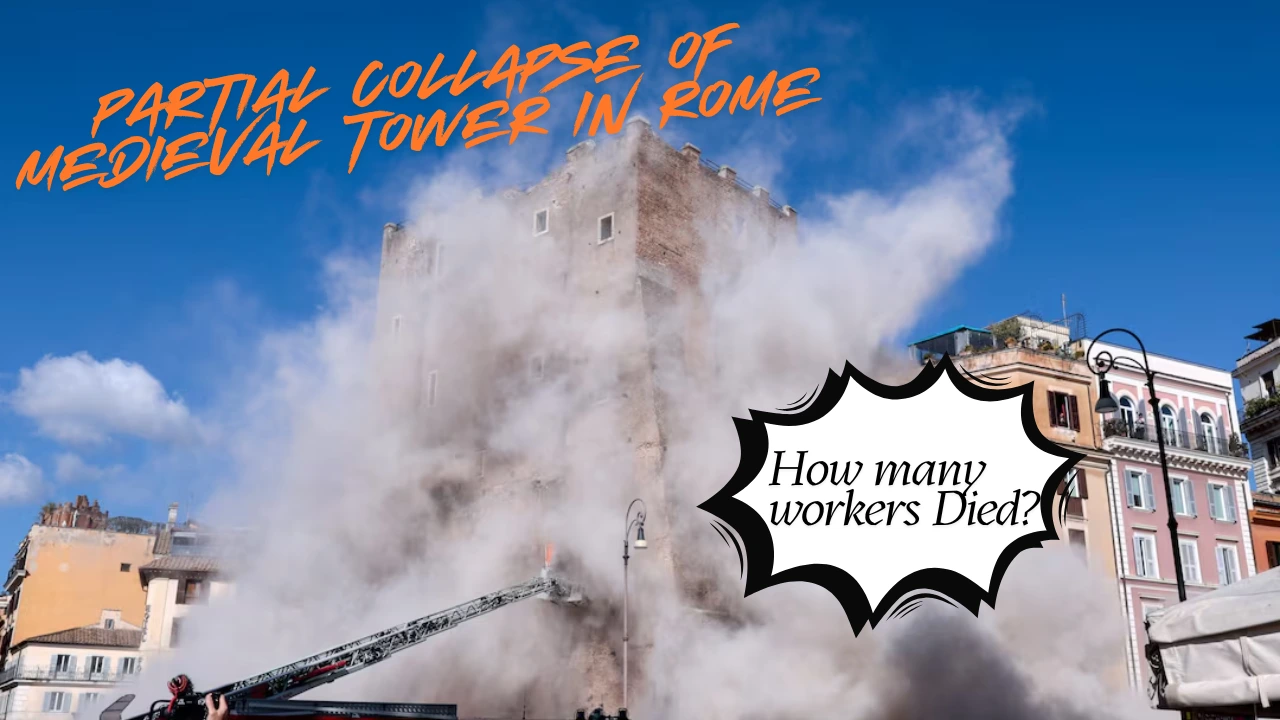
Worker dies after partial collapse of medieval tower in Rome, In the heart of Rome, where modern life brushes up against the living relics of a storied past, a tragic accident has cast a shadow over one of the city’s lesser-seen medieval landmarks. During restoration work on the 13th-century Torre dei Conti, a tower that once overlooked the imperial Forum and still stands near the bustle of the Colosseum, a section of the tower partially collapsed, tragically killing one construction worker and injuring others. What was meant to be a preservation effort has instead raised urgent questions about safety, heritage-conservation and the fragility of ancient structures in a modern city.
Worker dies after partial collapse of medieval tower in Rome-Overview
| Article on | Worker dies after partial collapse of medieval tower in Rome |
| Incident | Partial collapse of Torre dei Conti in Rome |
| Casualties | One worker killed, several injured |
| Location | Near the Colosseum, central Rome |
| Cause | Under investigation during restoration work |
| Built | 1238 – one of Rome’s oldest medieval towers |
The Collapse and Its Human Cost
On Monday morning, November 3, 2025, workers were engaged in restoration activities inside the Torre dei Conti, a tower built in 1238 by the brother of Pope Innocent III. At about 10:30 GMT, part of the tower’s southern buttress suddenly crumbled, sending masonry and debris down into the vicinity of the structure. Rescue efforts began swiftly, but the situation worsened when a second collapse occurred approximately ninety minutes later while emergency crews were still on-site.
Italian Prime Minister Giorgia Meloni expressed sorrow for the loss, noting the tragedy of a life lost while working to preserve Italy’s heritage. Meanwhile, the local public prosecutor’s office launched an investigation into whether safety protocols were followed and whether negligence played a role.
A Tower with a Long, Fragile History
The Torre dei Conti rises near the Via dei Fori Imperiali, the broad avenue that links Piazza Venezia and the Colosseum. Originally built in 1238 by Richard Conti, it once stood at 50-60 metres tall. Over the centuries, earthquakes and structural failures reduced its height to roughly 29 metres.
It has had a difficult life: medieval residence, buttressed structure, abandoned tower, outer decoration stripped, and finally a scheduled restoration. Prior to the collapse it had been closed to the public for years, and a refurbishment programme financed in part by European funds was underway aiming to turn the tower into a museum-conference space.
The Rescue, the Risk and the Questions
The rescue of the trapped worker was itself fraught with danger. Firefighters reported that each time they freed part of the victim’s body, further rubble fell and buried him again. The second collapse occurred while responders were still working, forcing them to retreat and use drones and suction tubes to remove debris. Onlookers, tourists and locals gathered, watching dust clouds rise from the tower; several said the collapse felt like an earthquake.
Now, with a worker dead and an investigation under way, the spotlight turns to health and safety oversight, the expertise of restoration contractors, and the appropriateness of working on an ancient structure in a high-traffic tourist zone. The fact that the tower is located in one of Rome’s busiest areas, near major archaeological sites and along a route used by thousands of visitors daily, heightens the gravity of the incident.
Heritage vs. Safety: Balancing Priorities
Heritage sites like the Torre dei Conti pose unique challenges. On one hand, the preservation of historical monuments is vital: they connect us with the past, attract tourists and form part of civic identity. On the other hand, the materials, construction methods and structural history of such buildings often mean they are inherently less predictable than new constructions.
When restoration work begins, it is not simply a matter of updating systems or cleaning surfaces; it often involves reinforcing centuries-old masonry, installing modern utilities, and working within tight urban settings. Working within these constraints means risk management must be rigorous: scaffolding must be stabilised, temporary supports must account for unknown deterioration, and surrounding public spaces must be secured.
Impacts and Wider Consequences
On a human level, the loss of a construction worker is tragic. From a heritage protection angle, this incident may delay the tower’s transformation into the museum and conference venue planned for it. Administratively, the investigation could lead to stricter oversight of restoration projects in Rome and beyond, and may revive debates over who bears responsibility when heritage renovations go wrong.
Frequently Asked Questions
Part of the medieval Torre dei Conti collapsed during restoration work.
Yes, one Romanian worker died and others were injured.
Near the Colosseum in central Rome.
It was under restoration to preserve the structure.
Cause unknown investigation is ongoing.