
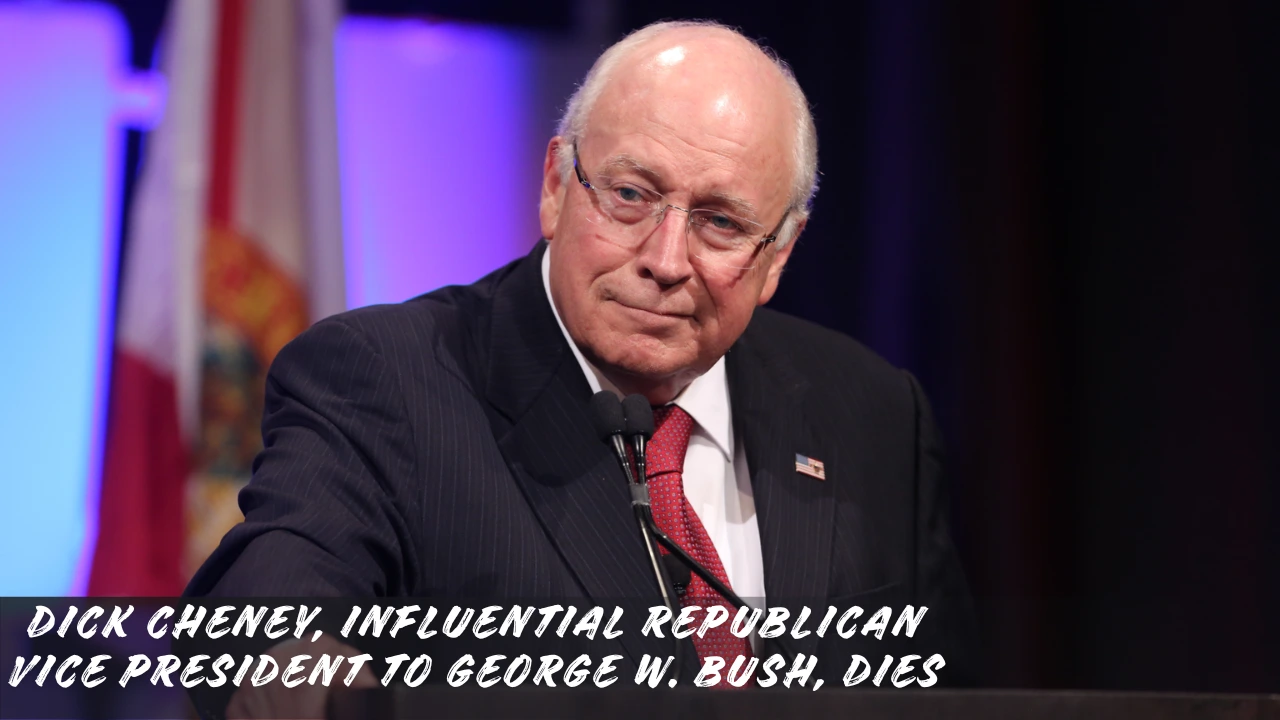
Dick Cheney, influential Republican vice president to George W. Bush, dies, on November 3, 2025, the United States lost one of its most consequential vice-presidents when Dick Cheney died at the age of 84, his passing attributed to complications from pneumonia and underlying cardiac and vascular disease. His death marks the end of a political career that spanned decades and left an indelible imprint on American governance, national security and the Republican Party. While revered by supporters for his resolute defense of American strength, he was equally criticized by opponents for the aggressive expansion of executive power and controversial foreign-policy decisions.
Dick Cheney, influential Republican vice president to George W. Bush, dies-Overview
| Article on | Dick Cheney, influential Republican vice president to George W. Bush, dies |
| Full Name | Richard Bruce Cheney |
| Born | January 30, 1941 – Lincoln, Nebraska, USA |
| Died | November 3, 2025 – Age 84 |
| Notable Role | 46th Vice President of the United States (2001–2009) |
| Legacy | Influential yet controversial leader known for shaping post-9/11 U.S. policy |
Early Life and Political Ascent
Born Richard Bruce Cheney on January 30, 1941, in Lincoln, Nebraska, he grew up in Wyoming and pursued his education at the University of Wyoming, where he earned both bachelor’s and master’s degrees in political science. His early career brought him to Washington, where he served as a congressional intern, then on to becoming the youngest White House Chief of Staff under President Gerald Ford.

The Role as Vice President (2001–2009)
When George W. Bush selected Cheney as his running mate in the 2000 election, it set the stage for one of the most powerful vice-presidencies in American history. Many historians argue that Cheney’s influence rivalled or even exceeded that of some presidents.
9/11 and the War on Terror
On September 11, 2001, the nation witnessed the worst terrorist attack on its soil. In the immediate aftermath, Cheney stepped into a critical role as part of the administration’s leadership team responding to the crisis. He helped guide the decision to invade Afghanistan, seeking to dismantle Al Qaeda and topple the Taliban government that harboured it.
The Iraq Invasion
Perhaps the most defining and controversial moment of Cheney’s vice-presidency came in March 2003, when the U.S. invaded Iraq. Cheney was a leading advocate of the policy, claiming Iraq possessed weapons of mass destruction (WMDs) and had ties to terrorist organisations. Later investigations found no operational WMD programme in Iraq and no firm ties between Saddam Hussein and Al Qaeda. The decision to invade remains one of the most contentious chapters in recent U.S. foreign-policy history.
Expansion of Executive Power & Surveillance
One of Cheney’s lasting legacies is his strong belief in the primacy of the presidency in matters of national security. He championed policies such as warrantless surveillance, enhanced interrogation techniques for detainees, and broad executive authority. Critics argue that these moves undermined civil liberties and the system of checks and balances; supporters contend they were necessary in the face of new forms of asymmetric threat.
Legacy, Controversies and Impact
While Cheney’s supporters lauded him as a decisive leader who prioritised American security, his detractors painted him as a shadowy figure pushing the nation into risky military adventures and eroding democratic norms. The “Darth Vader” or “Prince of Darkness” monikers reflected how he was perceived by many.
Political and Historical Evaluation
In the immediate aftermath of the Iraq war and during his second term, Cheney’s approval ratings fell to historic lows for a vice-president. Yet with time, some analysts have reassessed his influence more soberly: he played a major role in shaping U.S. strategy in the early 21st century, for better or worse. The Guardian noted:
“Cheney’s place in history will be dominated by the decision to invade Iraq.”
Health Challenges and Personal Episodes
Cheney’s personal health struggles were also well-known. He suffered his first heart attack at age 37, endured a series of cardiac events, and underwent a heart transplant in 2012. Another curious incident: while still vice-president, he accidentally shot a hunting companion, lawyer Harry Whittington, during a quail hunt in Texas in 2006, a fiasco that briefly captured public attention.
Later Political Divergence
In his post-vice-presidential years, Cheney remained politically active—yet his views began to diverge sharply from much of his party. He took a strong stance against Donald Trump, calling him “a greater threat to our republic” and in the 2024 election, stated he would vote for the Democrat Kamala Harris rather than the Republican nominee. His daughter, Liz Cheney, also became a high-profile voice against Trump, reflecting the elder Cheney’s evolving political identity.
Frequently Asked Questions
November 3, 2025, at age 84.
Complications from pneumonia and heart disease.
Serving as Vice President under George W. Bush (2001–2009) and shaping post-9/11 U.S. policy.
His role in the Iraq War, surveillance programs, and expansion of executive power.
Wrote memoirs, stayed politically active, and opposed Donald Trump.